Inside the clinic and beyond: How VCU dental and dental hygiene students are changing lives
At VCU School of Dentistry, community service and engagement is at the forefront of education. Throughout their time at VCU, dental and dental hygiene students apply the skills they have learned in the classroom to real-world situations. From volunteering at educational events, treating patients at Missions of Mercy events, to participating in the statewide service learning program, students enter the workforce with a well-rounded education and a deep understanding of the complexities of care.
-1920x1080.jpg)
Community engagement
Students spend so much of their time studying, treating patients in the clinics and pursuing their own interests and hobbies that it can be difficult to imagine having room to fit community service into their schedules as well. However, for many students, giving their free time to community service is a reminder of their goals and purpose as a healthcare professional.
During the 2024-2025 school year, there were 33 unique community service events led by dental and dental hygiene students throughout the Richmond community. Whether it be visiting elementary schools dressed in toothbrush costumes and teaching children about oral health, tabling at church and community events or handing out brochures on campus, the impact of these events are widespread.
Community engagement at VCU School of Dentistry is managed by Michelle McGregor, RDH, BS, M.Ed., Director of Community and Collaborative Partnerships.
McGregor’s goals with community engagement are twofold: to educate the community on oral health and also to expose them to what VCU School of Dentistry has to offer, whether it be for a patient in need of dental care or a prospective student.
“A lot of people are unaware of all that VCU School of Dentistry has to offer,” McGregor said. “Or they might not realize what opportunities are available to them. Many people perceive dental care or attending dental care as a luxury that is out of their reach. It’s our goal to bridge that gap and directly give the community resources they need for their own oral health.”
Fourth-year dental student and Richmond native Ria Holloman finds volunteering in Richmond especially meaningful because it gives her an opportunity to give back to the community that raised her.
“While we spend a significant portion of our education serving patients in the clinic, volunteering adds another layer by helping us better understand our patients’ lived experiences,” said Holloman. “I often tell my patients that while I am there to help them, they are also helping me by allowing me the space to grow, learn, and become a better clinician. Community involvement fosters humility, gratitude and a deeper sense of responsibility, qualities that are essential for becoming a well-rounded dentist.”
Holloman serves as president of the Student National Dental Association. Among the many ways they volunteer in the community and provide oral health resources and education, they notably hold the annual Impressions Day to give undergraduate students from around the region a taste of the admissions process and what they can expect from dental school.
“Leading Impressions Day felt like a full-circle moment for me,” said Holloman. “I vividly remember sitting in those same chairs just a few years ago as a pre-dental student, unsure of what my future in dentistry would look like but hopeful and inspired by the people around me.”
The values that Holloman acquired from SNDA and community engagement during her dental education are ones that she plans to carry with her into her career post-graduation, she said.
“Being able to serve as a resource and source of encouragement for others reminds me of the mentors who once poured into me, and I hope to continue being that same figure for future students pursuing dentistry,” said Holloman.
Service Learning Program
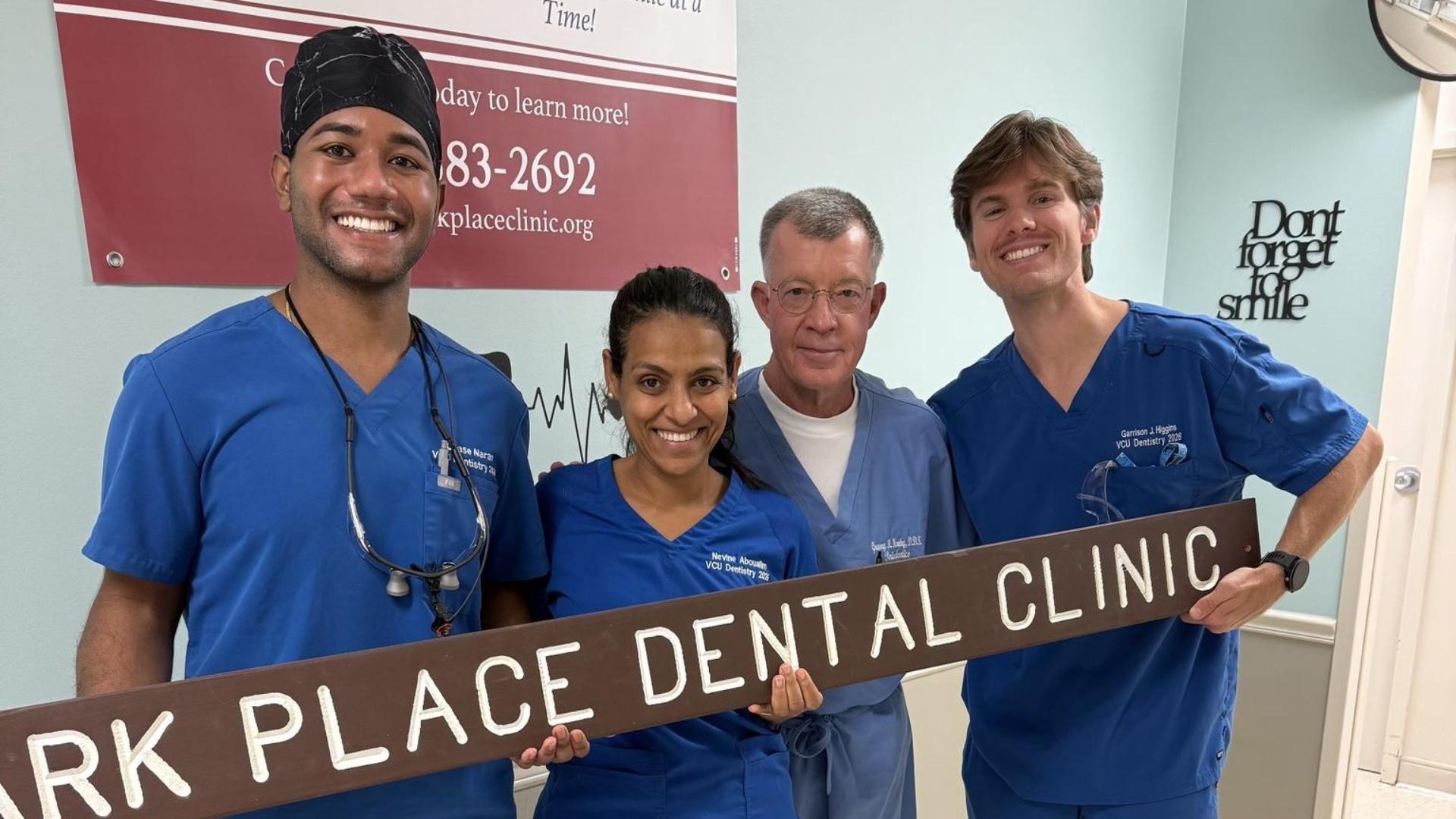
As part of their didactic curriculum, dental students take a public health course during their second year where they learn about access to care issues and how to help patients in underserved communities. During their fourth year, they take that knowledge out into the real world by traveling throughout the state and working at community health clinics through the Commonwealth.
Through the service learning program, students learn the intricacies of providing healthcare, from scheduling, practice management, to creating treatment plans. It’s an opportunity to apply the skills they learned in the classroom to real-world scenarios. Most importantly, they are helping people in need.
Dental students provide services at 14 service-l learning sites across the Commonwealth, spending approximately 25–30 days in their D4 year, while dental hygiene students complete 20–25 days during their senior yearr.
“Being able to see firsthand the need that is present and acquire a deeper understanding of barriers to oral healthcare is so important,” McGregor said. “The students are coming back with more knowledge about being a provider and also how to better connect with and directly help the underserved communities.”
Access to care is a significant issue throughout the Commonwealth, particularly in rural areas where there are fewer dental clinics. Barriers such as lack of dental education, finances, healthcare and transportation can result in people going years without receiving dental care. Tooth decay and other oral health issues don’t just end with the mouth, but can result in many other significant systemic health issues.
Community health clinics provide patients with services such as teeth cleanings, fillings, root canals, extractions, dentures and dental hygiene education. Many of the clinics extend beyond dental care, with other healthcare professionals in different fields providing services and resources.
For many students, their experiences in service learning are deeply meaningful. Several alumni have since gone on to either volunteer or work full time in free clinics throughout the Commonwealth. It’s a full-circle moment; the students who spent hours learning and helping in the community health clinics now get to mentor the next group of students and continue to promote the ideas of clinical care that they learned in dental school.
“Giving back can come in many forms; it doesn’t have to be financially but rather just by giving time,” McGregor said. “Even just volunteering for one day each month makes a life-changing difference in patients’ lives.”
Darrell Boyce, D.D.S., graduated from VCU School of Dentistry in 2023. Since then, he has continued to give back by volunteering at the Chesapeake Care Clinic while also working in private practice. His services at the clinic started even before the service learning program; he first volunteered in 2017.
Boyce’s experiences at the Chesapeake Care Clinic are deeply meaningful because it serves the community he calls home.
“It was nice to come home and see familiar faces and give back to my community in this way,” Boyce said. “You form a lot of meaningful relationships with both the other service providers and with the patients. They’re deeply grateful for the care we provide.”
As a volunteer, he now also has the opportunity to be a mentor to current dental students who are on rotation at the clinic.
“I used to see the fourth year students in the hallways as my peers,” Boyce said. “It’s great to reconnect with them and see how much they’ve grown. I’m proud to see them changing lives here.”
-1920x1080.jpg)
Missions of Mercy
For 25 years, the Virginia Dental Association Foundation has been hosting Missions of Mercy events throughout the Commonwealth. Founded by affiliate faculty member Terry Dickinson, D.D.S., these events have given over 25,000 patients reasons to smile by providing them with free oral health care and life changing dental services.
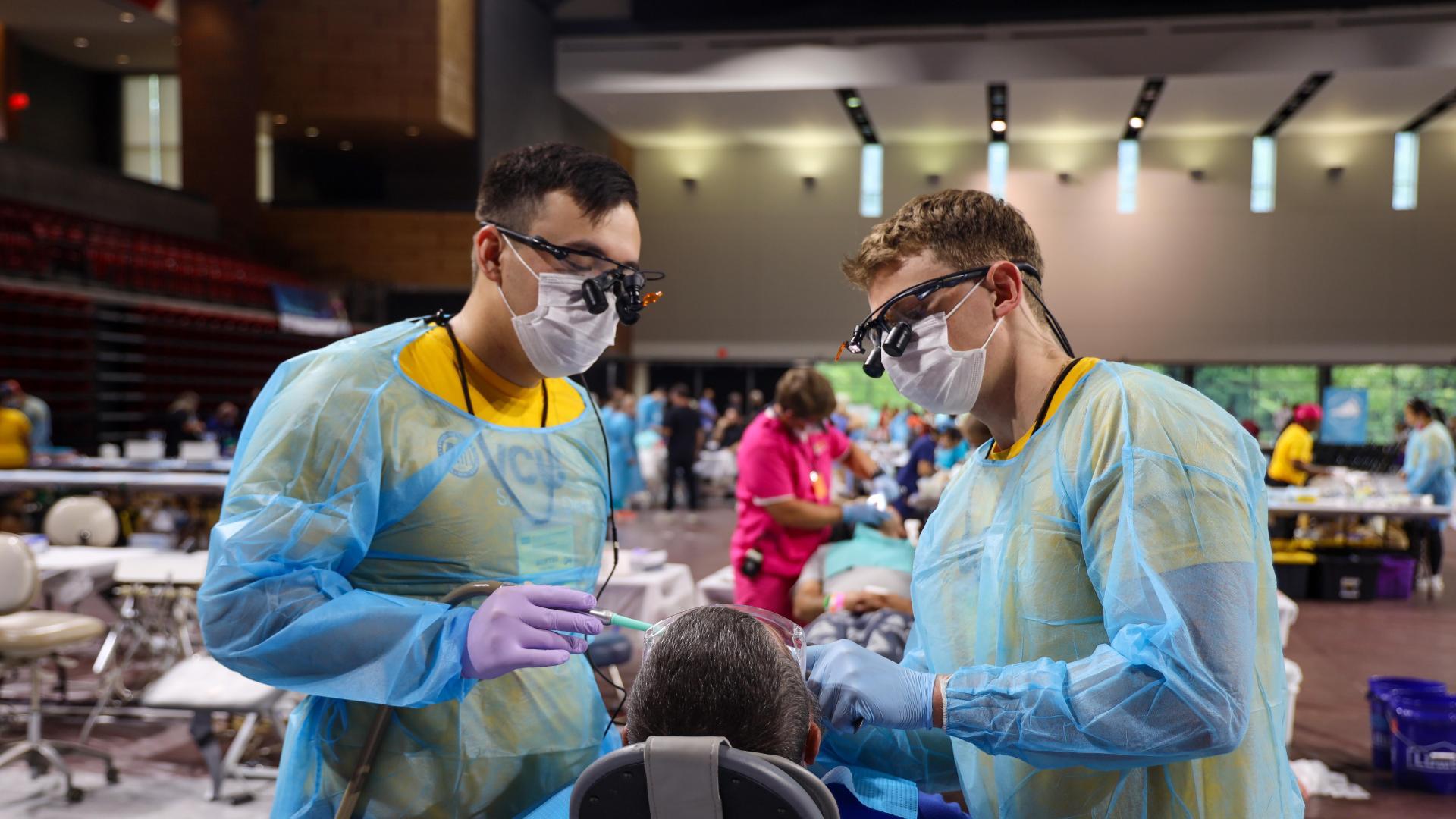
VCU School of Dentistry students and alumni dedicate countless hours of their lives to serving the underserved at these events. During the 2024-2025 academic year, 1265 patients were provided free treatment at MoM projects with an estimated monetary value of $1,382,273.
The fully functioning dental clinic often located in gymnasiums or event spaces doesn’t pop up overnight. The process typically begins weeks before the project, with students inventorying the two box trucks and organizing supplies. In the days leading up to treatment, pairs of students drive the trucks, sometimes up to six hours and through steep and narrow rural roads, to the clinic location and meet the rest of the volunteers. Everyone then spends several hours unloading supplies, setting up dental chairs, organizing supply tables and transforming the space into a dental clinic.
For fourth-year dental students Hunter Smith and Jacob Dougall, they realized after their first project that MoM was more than just volunteering, it was a chance to make a real difference and experience the powerful impact dentistry can have on people’s lives.
“Growing up in the rural town of Madison, Virginia, helped me understand how limited access to healthcare can impact a community,” said Smith. “Being able to use my dental training to directly help individuals in need felt like a meaningful and tangible way to give back.”
Smith and Dougall share the responsibility of driving the trucks of supplies to the clinic sites. They recalled the challenges of driving the large trucks through rural backroads and up winding mountain roads to get to the clinic site.
“The process can be a lot and sometimes fatiguing but exciting to complete,” said Dougall. “It takes teamwork, problem-solving, and flexibility. While challenges arise, overcoming them together makes the experience even more rewarding and strengthens the sense of accomplishment.”